
一杯咖啡和茶之後,剩餘材料如何走進生活空間?倫敦 Innovus Lab 的材料再造計畫
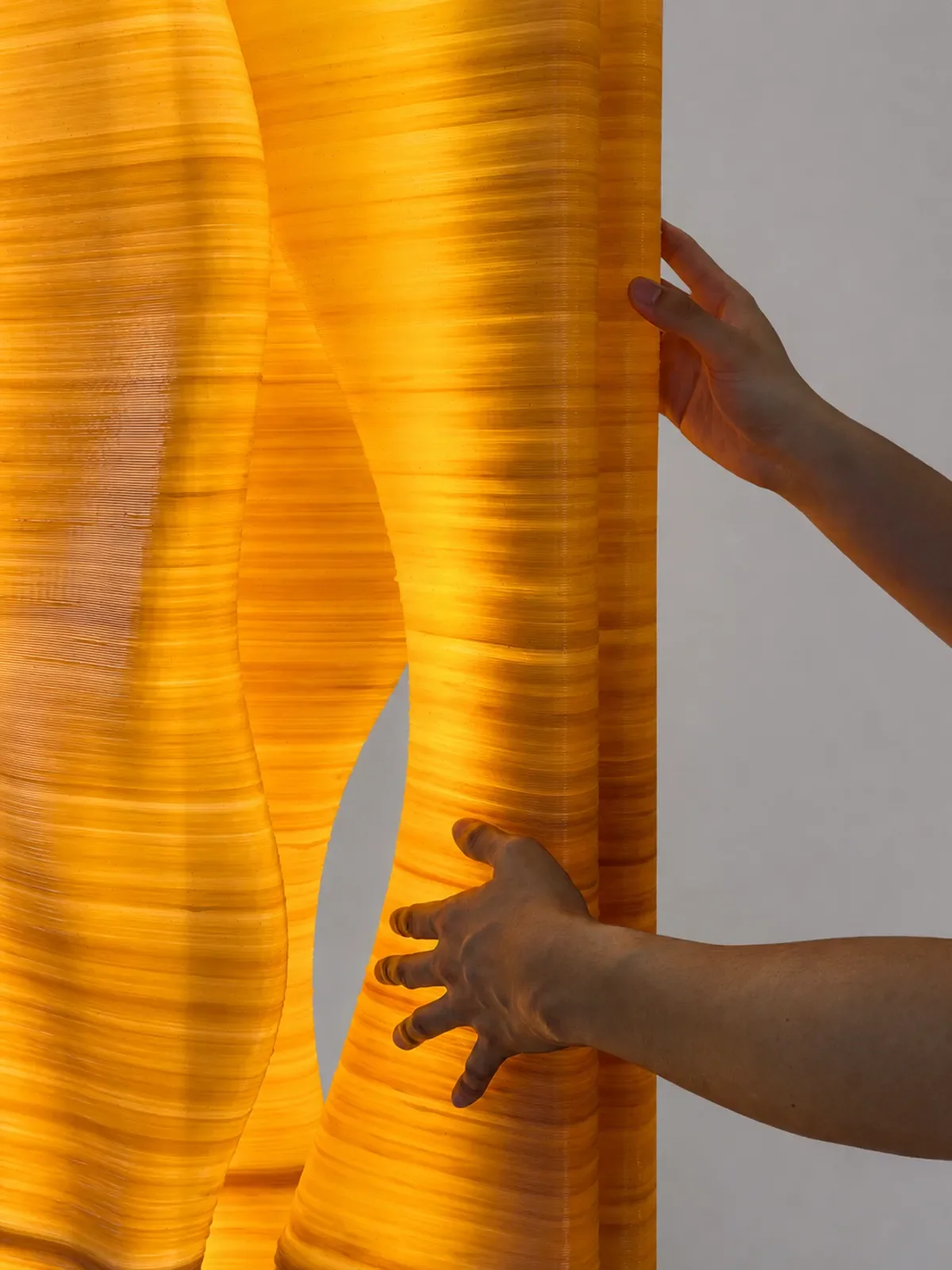
Undetermined Shore © ChaoChun Kung
[ZH]
在城市的生活步調裡,飲食往往伴隨著快速且單向的物質消耗。一杯咖啡或茶飲萃取完成後,留在吧台濾網與渣桶裡的剩餘物,隨著例行清理,迅速走向廢棄的終點。這些生命週期短暫的殘渣,看似與構築空間的家具和器物毫無關聯,卻在設計師龔照峻的實驗中產生了交集。
當廢棄茶葉與咖啡渣經過乾燥、研磨,與生物基塑料結合,再透過運算設計與 3D 列印重新成形,原本即將被丟棄的植物碎屑,逐步轉化為具備實際功能的家具、燈具與空間裝置。
[EN]
After the Last Sip: How Everyday Residues Reshape Living Spaces — Innovus Lab’s Material Repurposing Project
In urban life, coffee and tea are part of everyday routines. Once a drink has been prepared, the used leaves and grounds are usually discarded, their journey seemingly coming to an end. These everyday residues rarely find their way into the furniture and objects that shape our living spaces. Yet designer Chao-Chun Kung has found a connection between the two. By drying and grinding discarded tea leaves and coffee grounds, then combining them with biodegradable polymers and shaping the resulting material through computational design and 3D printing, he is exploring how everyday waste can be transformed into functional furniture, lighting and spatial installations.
© Hsin Huang
[ZH]
旅居倫敦的台灣設計師龔照峻,正是這場材料實驗的發起者。畢業於國立臺灣科技大學建築系後,他獲得教育部獎學金前往倫敦大學學院巴特雷建築學院(UCL Bartlett School of Architecture),攻讀生物整合設計碩士(Bio-Integrated Design)。在學期間,他將研究重心放在生物材料與建築構築之間的關係,從菌絲體的抗壓表現、藻類的附著特性,到貝殼微粒與生物膠質結合後形成的多孔基質,逐步摸索有機材料在建築與物件製造上的應用可能。
這段研究經歷改變了他看待設計的邏輯。材料本身的密度、韌性、透光性與成型限制,開始成為造型發展的重要依據。他逐漸從材料特性出發,透過反覆測試,摸索結構與材料之間的平衡。
[EN]
Based in London, the Taiwanese designer has made material research a central part of his practice. After graduating in architecture from National Taiwan University of Science and Technology, he received a scholarship from Taiwan’s Ministry of Education to pursue an MA in Bio-Integrated Design at The Bartlett School of Architecture, UCL. During his postgraduate studies, his research explored the relationship between biological materials and architecture. His investigations included the compressive properties of mycelium, the adhesive qualities of microalgae, and porous substrates made by combining shell particles with bio-gels.
These studies shaped the way Kung approaches design. He began to consider the inherent qualities of materials, from their density and strength to their translucency and limitations during fabrication. Through repeated testing and prototyping, he explores how these properties can inform the form and structure of an object, seeking a balance between structural performance and material character.
ORBIT © ChaoChun Kung
[ZH]
從建築事務所到 Innovus Lab,重新尋找材料的應用性
取得學位後,龔照峻進入倫敦當地的建築事務所,參與大型旅宿與商業空間設計,工作內容涵蓋工程規範、施工圖面與專案執行。工作之餘,他仍持續投入有機複合材料研究。
在教育部「青年百億海外圓夢基金計畫」支持下,他展開個人研究計畫,並創立設計工作室 Innovus Lab,串連倫敦與台灣的研發資源,結合材料測試、計算設計與數位製造,逐步發展家具、燈具、生活物件及空間裝置。
[EN]
From Architectural Practice to Innovus Lab
After completing his master’s degree, Kung joined an architectural practice in London, where he worked on large-scale hospitality and commercial projects. Alongside his professional work, he continued to develop his own research into organic composite materials.
With support from Taiwan’s Ministry of Education Youth Overseas Dream Fund Program, Kung began an independent research project and established Innovus Lab. Bringing together resources from London and Taiwan, the studio combines material testing, computational design and digital fabrication to explore new possibilities for furniture, lighting, everyday objects and spatial installations.
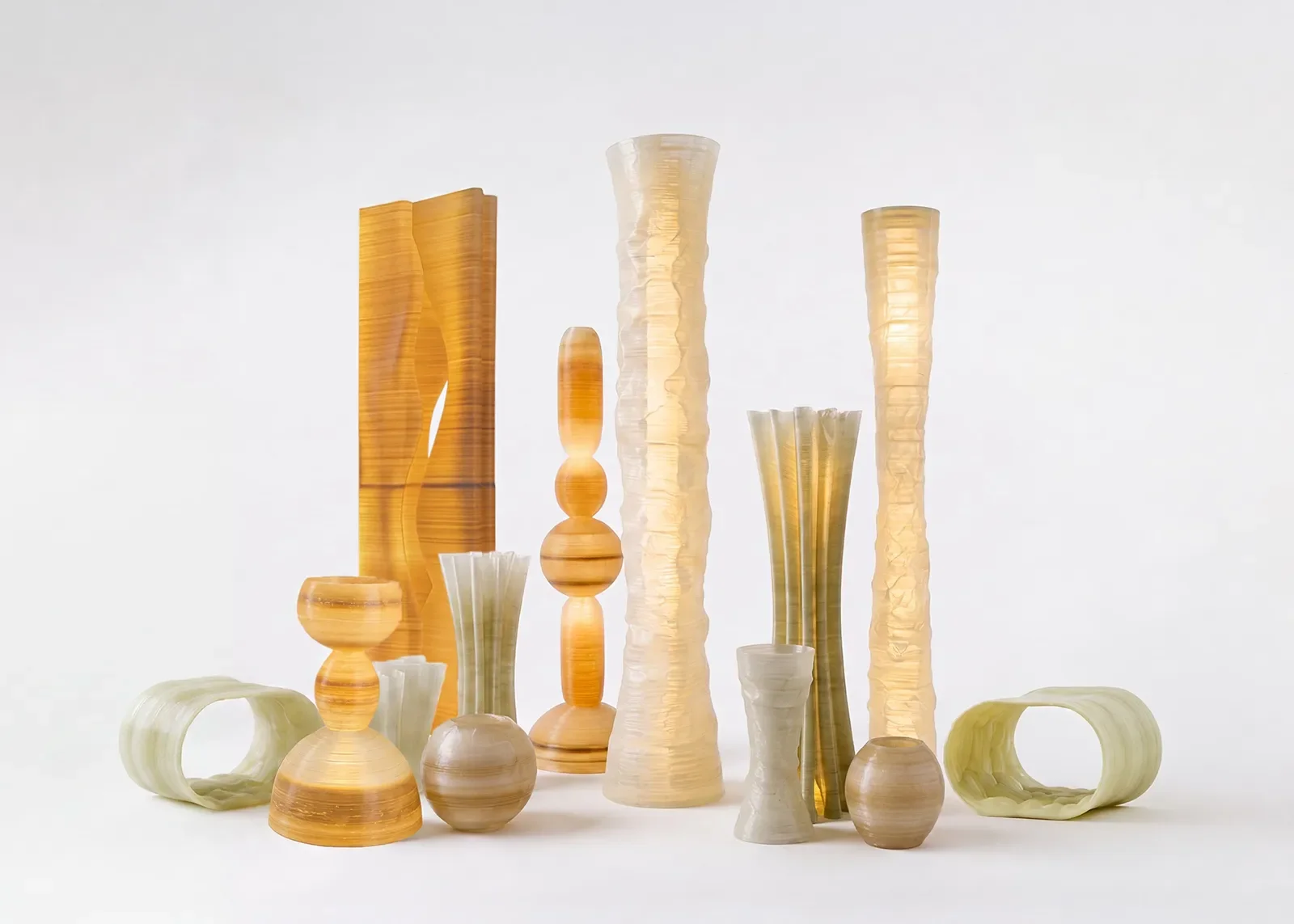
《After the Last Sip》 © ChaoChun Kung
[ZH]
而這份對剩餘資材的關注,源自童年在雲林的成長經驗。每逢稻作收割季節,經常看見農田露天焚燒稻草所升起的濃煙,也促使他思考,這些農業剩餘資材能否以其他方式重新利用。
來到倫敦後,研究目標逐漸延伸至城市日常。街區裡密集的咖啡館與茶飲店,每天產生大量茶葉與咖啡渣,多數最後面臨被丟棄的命運。這讓他嘗試將過去對農業副產物的研究,帶進更貼近日常生活的材料應用之中。
[EN]
Kung’s interest in reusing leftover materials can be traced back to his childhood in Yunlin, Taiwan. During the rice harvest seasons, the open-air burning of rice straw was a familiar sight across the countryside. Seeing the smoke produced by this practice left a lasting impression on him, prompting him to consider how agricultural residues might be put to use in other ways.
After moving to London, his research expanded to include materials generated by everyday urban consumption. Coffee shops and tea shops across the city produce large quantities of used coffee grounds and tea leaves. Much of this organic waste is discarded after brewing, prompting Kung to explore whether these materials could become part of the composite materials he had been developing.
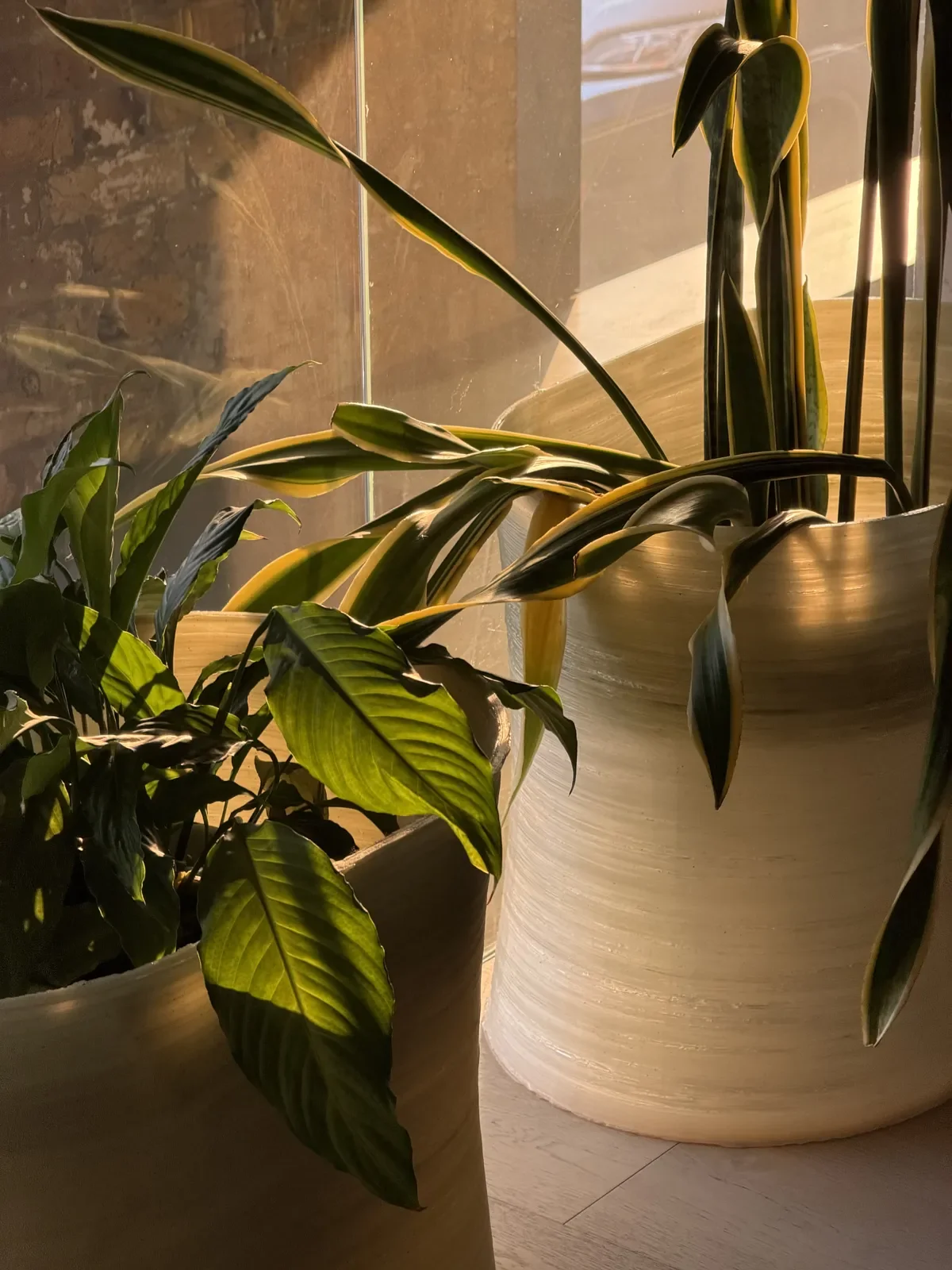
Soft Cell © ChaoChun Kung
[ZH]
用茶葉與咖啡渣調配可列印的材料
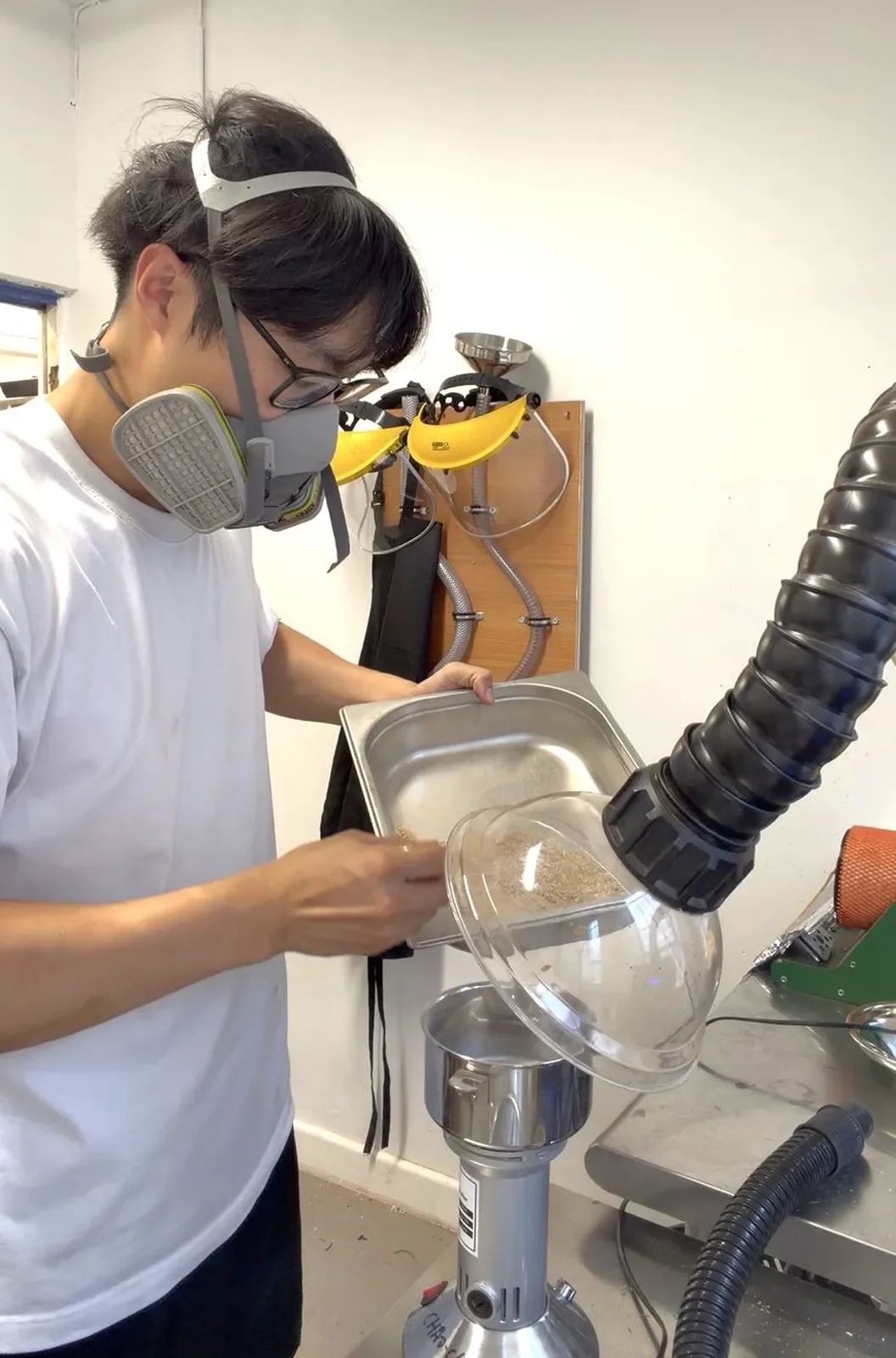
為了取得穩定的實驗材料,龔照峻透過在咖啡廳與手搖飲店工作的朋友,定期收集飲用後的茶葉與咖啡渣,並依照不同品類分別封裝。然而,這些剛取出的有機物質含有大量水分,容易發霉,也無法直接進入製造流程。因此,材料的前置處理就成為實驗的第一道關卡。
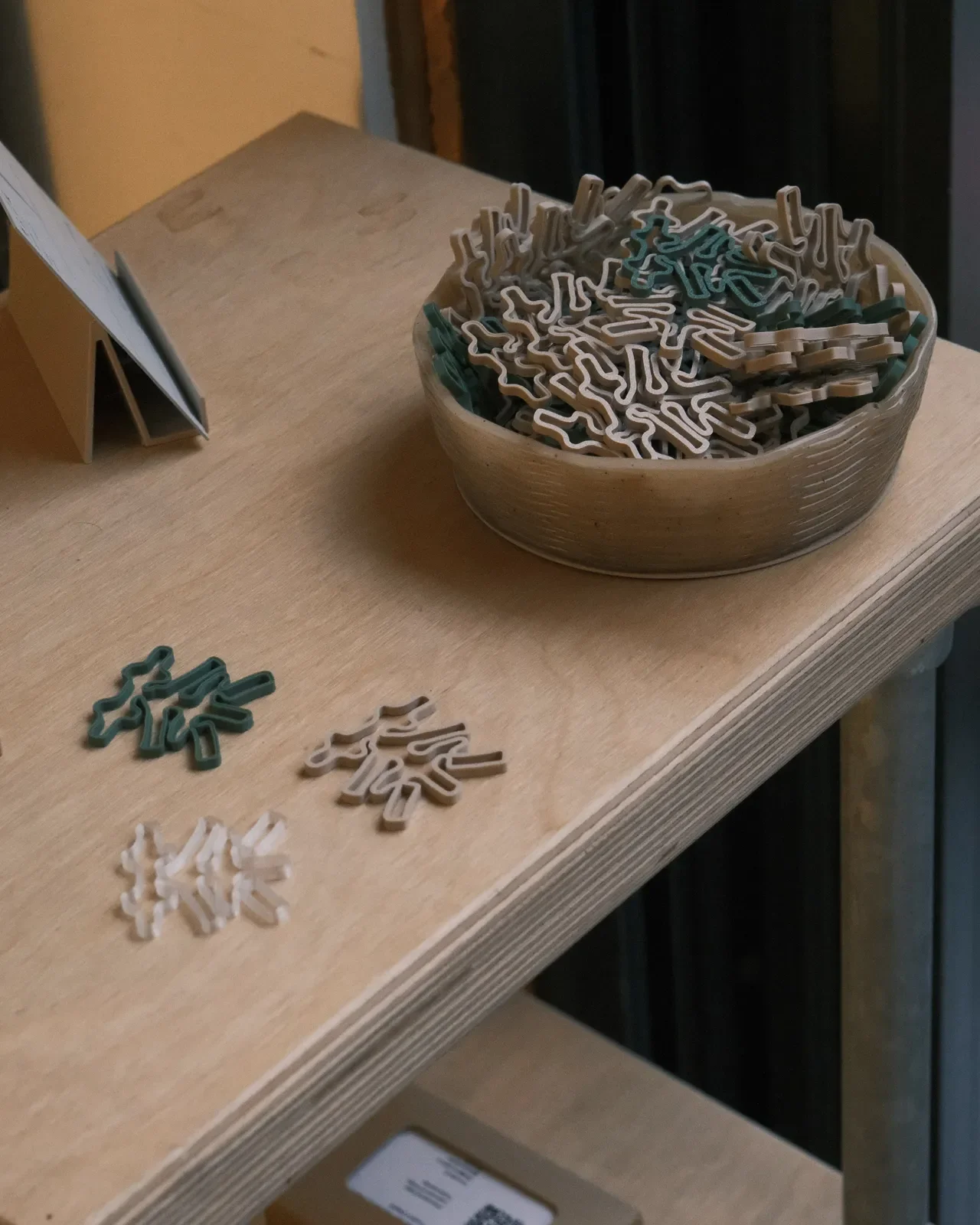
首先,需先將茶葉與咖啡渣均勻鋪平,經過一至兩天的乾燥,再透過機械研磨成細緻顆粒,最後依照比例混入可生物降解的聚乳酸(PLA),製成適合 3D 列印使用的複合材料。從原料收集、乾燥、研磨到配方調整,每一個步驟都牽動著後續的成型效果。
[EN]
Turning Tea Leaves and Coffee Grounds into Printable Materials
To build a consistent supply of raw materials, Kung began collecting used tea leaves and coffee grounds through friends working in London’s cafés and tea shops, sorting them into separate batches for use in the studio.
When freshly collected, these wet residues contain high levels of moisture, making them prone to mould and impossible to process directly. Preparing the materials therefore became an essential first step in the experiment.
The collected residues are spread out and dried for one to two days before being mechanically ground into fine particles. They are then mixed with biodegradable polylactic acid (PLA) to create a composite material suitable for 3D printing. Each stage, from drying and grinding to adjusting the material proportions, affects how the mixture flows through the printer and how it performs once formed.
© ChaoChun Kung
[ZH]
當茶葉與咖啡渣轉化為可供列印的複合材料,龔照峻也開始探索它們在物件上的表現方式。不同茶種與咖啡渣所帶有的色澤、顆粒及纖維特徵,經過乾燥、研磨與混料後,會在成品表面留下痕跡。隨著 3D 列印逐層堆疊,這些原本細微的材料差異逐漸形成物件表面的紋理,也讓原料本身成為造型設計的一部分。
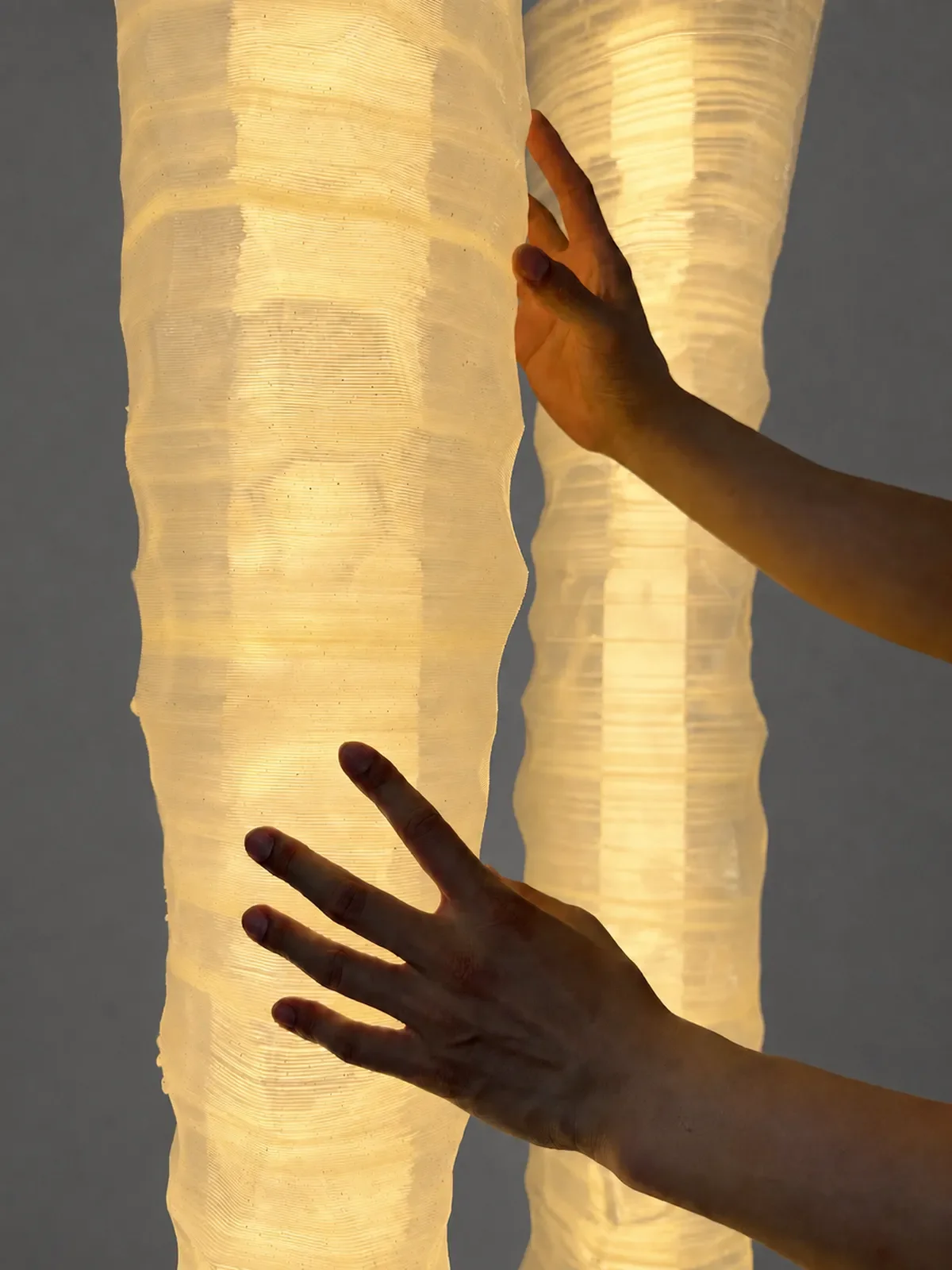
他也透過調整茶葉粉末的比例與投料方式,改變列印時的色澤表現,讓不同深淺的色調隨著材料沉積交錯分布。當燈光穿過帶有植物微粒的複合材料,顆粒與層疊紋理也會呈現不同程度的透光效果。
[EN]
With the composite ready for printing, Kung began exploring its visual qualities through a series of objects. The different colours, particles and fibrous textures of various teas and coffee grounds remain visible in the finished pieces. As the printer deposits the material layer by layer, these details become part of the surface, giving each object a texture shaped by its original ingredients.
He also experimented with adjusting the proportion of tea powder and the way it was fed into the printer, producing subtle variations in tone across the surface. When light passes through the composite, the embedded plant particles and printed layers create variations in translucency, adding another dimension to the material’s appearance.
© ChaoChun Kung
[ZH]
利用大型專業機械,打開大型曲面的製作可能
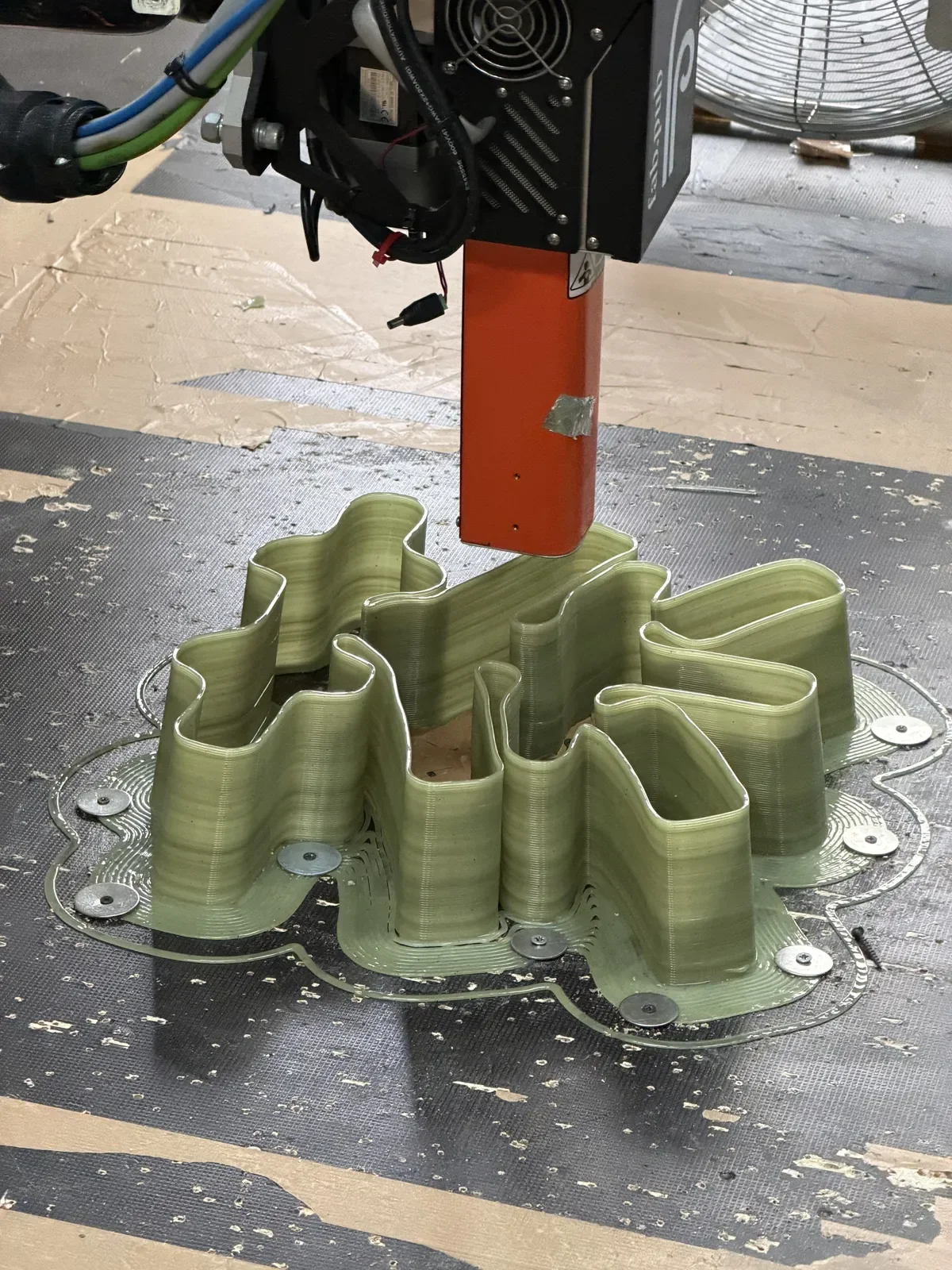
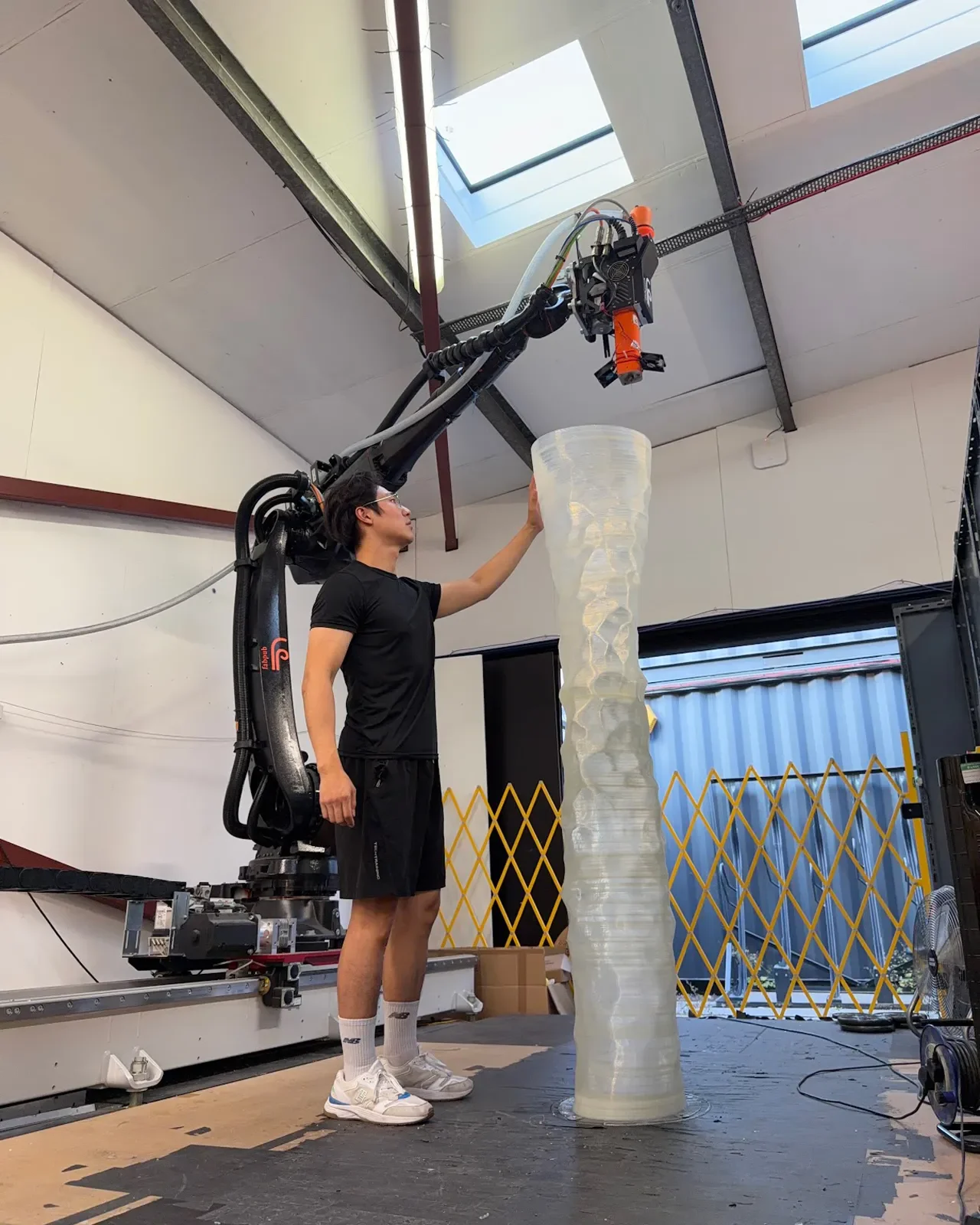
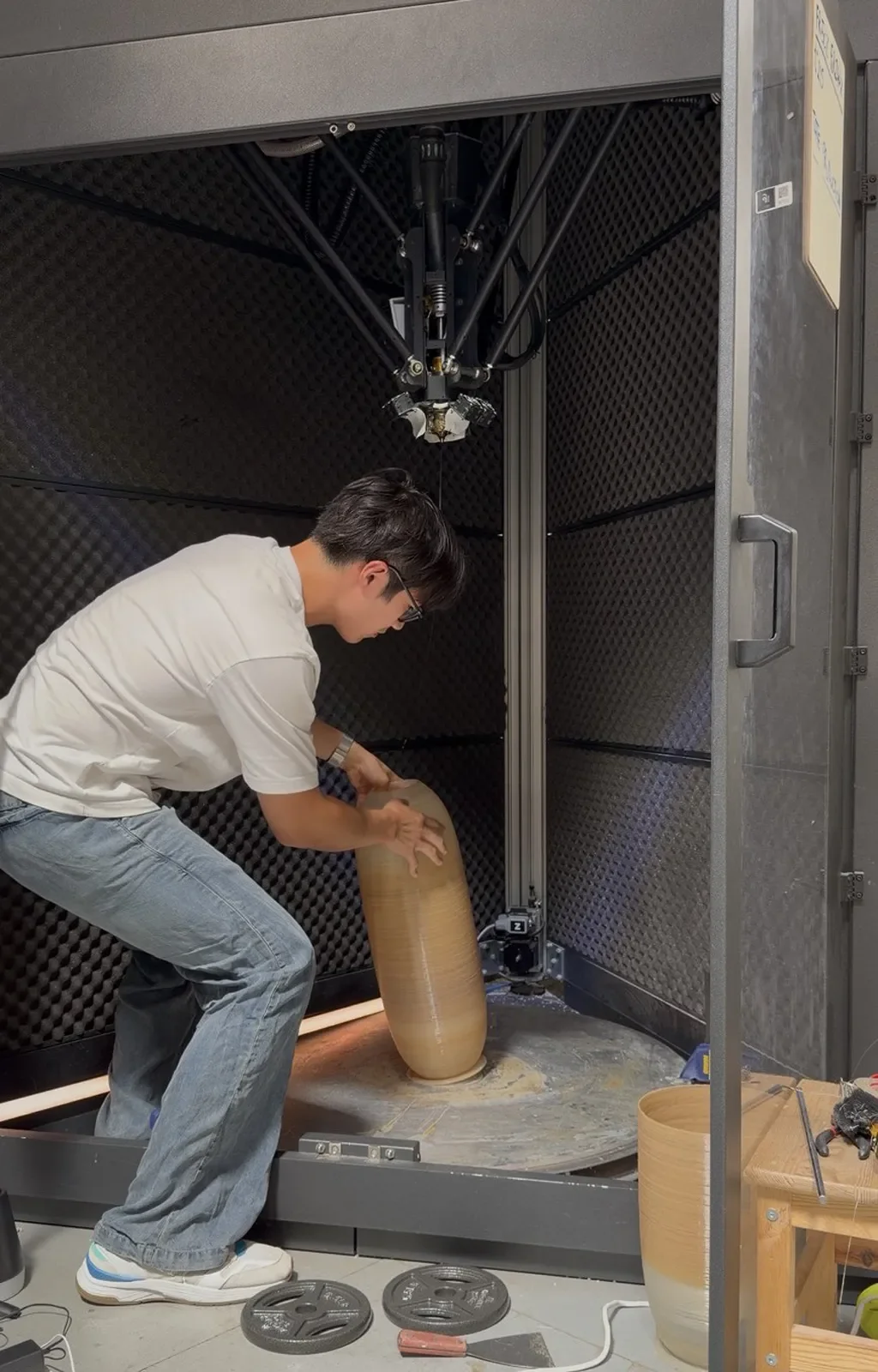
材料配方逐漸穩定後,龔照峻開始將實驗推向大型物件製作。他與倫敦東區的 3D 列印工坊 Fab.Pub 合作,運用工業級六軸機械手臂,搭配客製化加熱擠出噴頭(Pellet Extruder),探索大尺度列印的可能。
一般桌上型 3D 列印機主要沿水平面逐層堆疊材料,遇到複雜曲面或懸挑造型時,通常需要額外列印支撐結構。然而在大尺度列印的情境下,高溫熔膠的大出料量會讓支撐材與本體緊密咬合,拆除時極易直接損傷表面與結構。六軸機械手臂則能透過多方向旋轉與角度調整,改變噴嘴的出料方向,讓材料沿著預先規劃的空間路徑沉積,進而減少對支撐結構的依賴,完成更複雜的立體造型。
這也讓設計必須同時考量列印路徑、材料沉積方向與物件的整體結構。龔照峻透過計算模型規劃製作路徑,再依實際成型結果調整參數,讓設計構想逐步落實為實體物件。
[EN]
Opening Up New Possibilities for Large-Scale Surfaces
As the material formulation became more stable, Kung began exploring larger-scale objects. In collaboration with Fab.Pub, a digital fabrication workshop in East London, he worked with an industrial six-axis robotic arm fitted with a customised pellet extruder.
Conventional desktop 3D printers generally build objects along three axes, depositing material in horizontal layers. When a design includes steep curves or overhanging forms, additional support structures are often needed during printing. These supports can be difficult to remove, particularly when working with larger objects, and may affect the surface of the finished piece.
A six-axis robotic arm offers greater flexibility in controlling the direction of material deposition. By adjusting the angle and rotation of the extrusion head, it can follow more complex three-dimensional paths, allowing material to build along curved surfaces from different directions. This reduces the need for support structures and makes a wider range of forms possible.
This process requires continuous calibration between the digital model, the print path, and the physical properties of the composite. Kung uses computational scripts to generate toolpaths, then adjusts the printing parameters through repeated physical tests. Each trial helps him understand how the material responds to different angles and structures, bringing digital designs closer to workable physical forms.
© ChaoChun Kung
Iced Tea © ChaoChun Kung
[ZH]
在造型自由與材料極限之間,尋找物件的理想型態
對龔照峻而言,機械手臂提供了更大的造型自由度,卻也讓材料配方面臨更嚴苛的考驗。
當茶葉與咖啡渣粉末混入熔融聚合物中,微粒比例會直接影響出料穩定度。粉末含量過高,容易在持續加熱的過程中造成噴頭堵塞;含量過低,則難以呈現原料本身的顆粒質感。此外,環境溫度與濕度的變化,也會影響材料冷卻後的收縮與成型表現。
[EN]
Working Within Material Limits
Although the robotic arm allows greater freedom in shaping an object, it also places new demands on the material itself.
The proportion of tea and coffee particles in the composite has a direct effect on its flow during printing. Too much powder can cause the nozzle to become blocked, while too little reduces the presence of the original material in the finished surface. Temperature and humidity also affect how the material shrinks and holds its shape as it cools.
© ChaoChun Kung
[ZH]
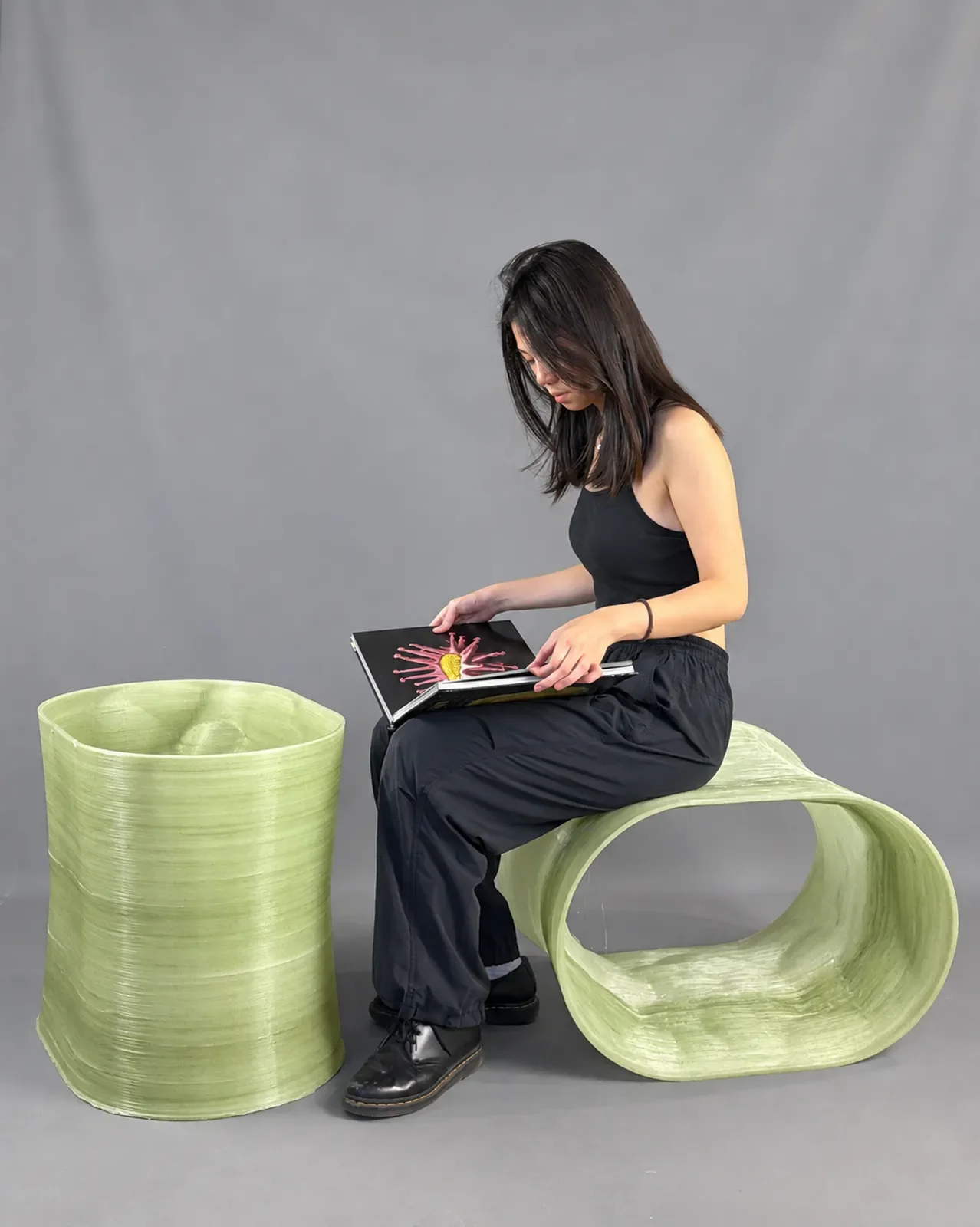
以 Soft Cell 為例,龔照峻最初以矮凳為設計方向,希望透過流暢的外部曲線,搭配內側如氣泡般起伏的立體結構,創造兼具造型與承重功能的物件。然而,第一件原型完成後,他實際試坐,發現多層曲面在承受重量時仍有結構脆化的疑慮,顯示現階段的材料配方與結構設計仍有改善空間。
因此,現階段他先保留 Soft Cell 的造型特色,將作品延伸為落地盆器或矮几,讓原型以其他形式進入實際使用;至於承重所需的材料強度,則留待下一階段持續測試與改良。從出料狀況、表面紋理到結構表現,每次實驗結果都成為後續設計調整的參考。
[EN]
These challenges became particularly clear during the development of Soft Cell. Kung originally conceived the piece as a stool, with a smooth outer form enclosing a bubble-like internal structure. After completing the first full-scale prototype, he tested it by sitting on it and found that the curved, layered structure was too fragile to support the required weight. The result highlighted the need for further development of both the material formulation and the object’s structural design.
Kung then began exploring other possible uses for Soft Cell, including a floor planter or a low table. This allowed him to continue developing the original form while investigating ways to improve the material’s strength. The process reflects an important part of his practice: each physical test provides information that can guide the next stage of material development and design.
Soft Cell © ChaoChun Kung
[ZH]
漢字「茶」到近兩米高立燈,讓文化意象進入三維空間
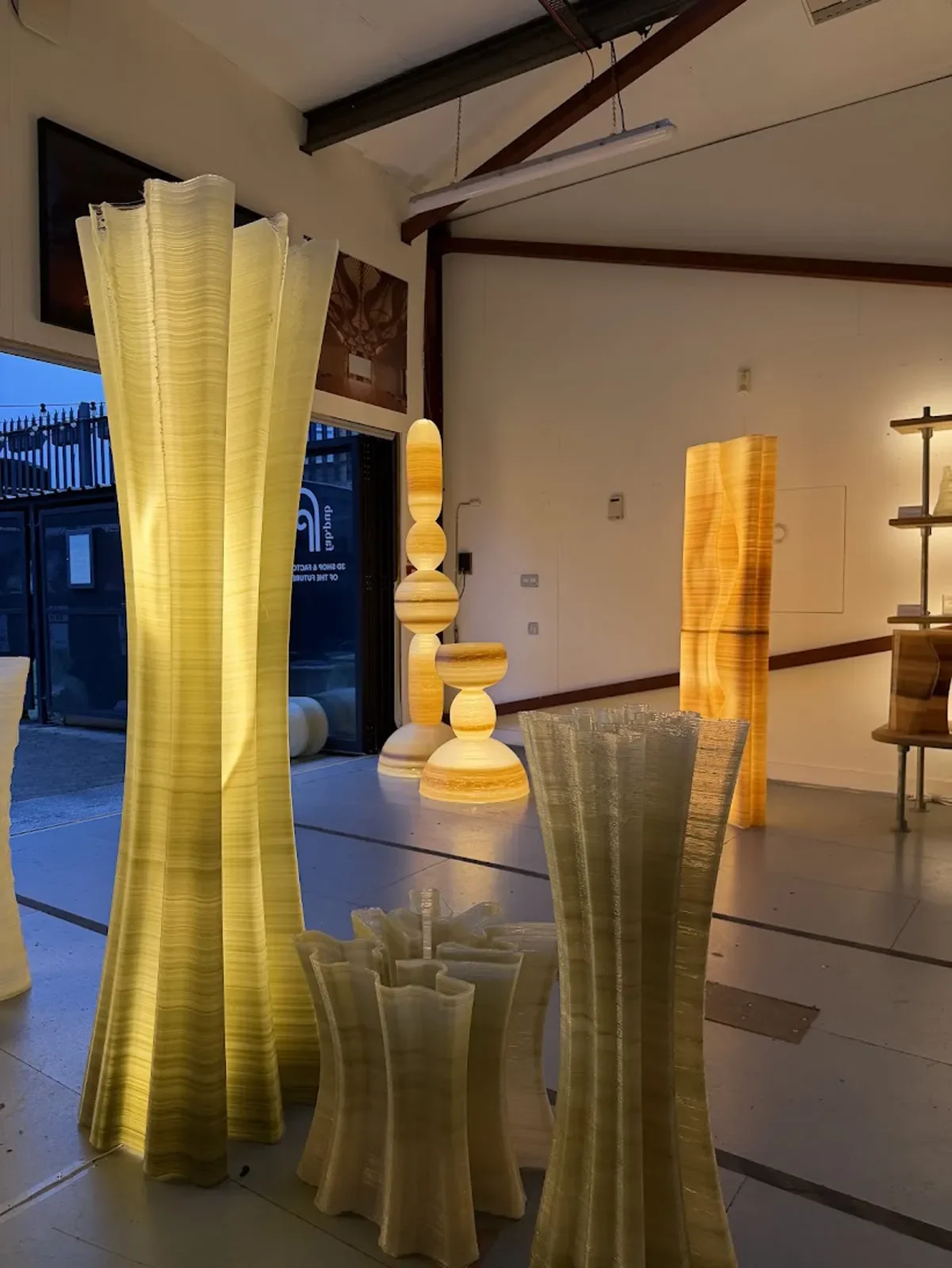
2026 年 9 月,這些材料實驗正式集結為《After the Last Sip》,於倫敦設計節期間在 Fab.Pub 展出。展覽由龔照峻發起並策劃,劉芷含負責空間策展,透過展場動線與作品配置,串聯材料樣品、製造工具、家具及燈具,呈現從原料處理到物件成型的完整過程。
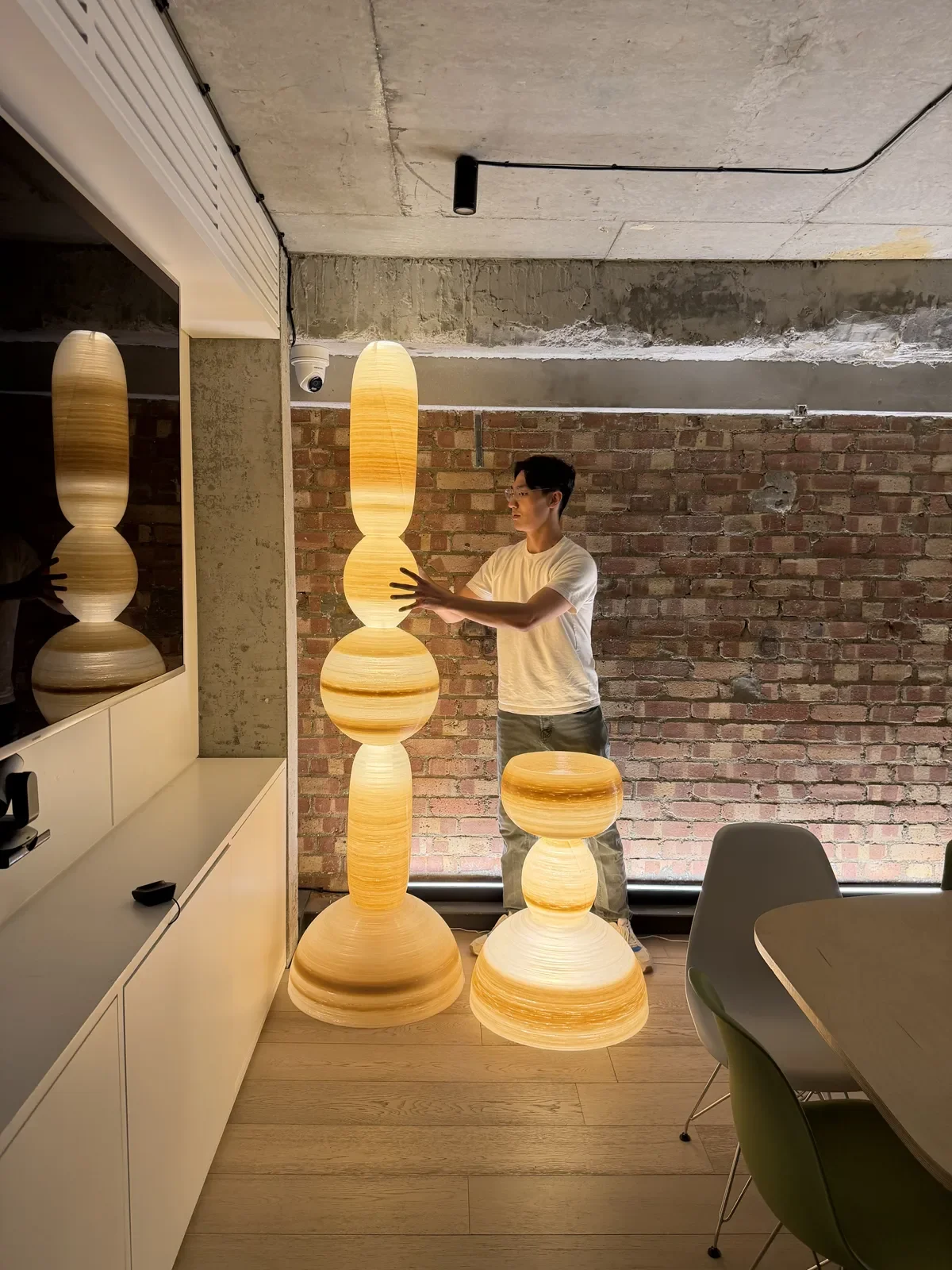
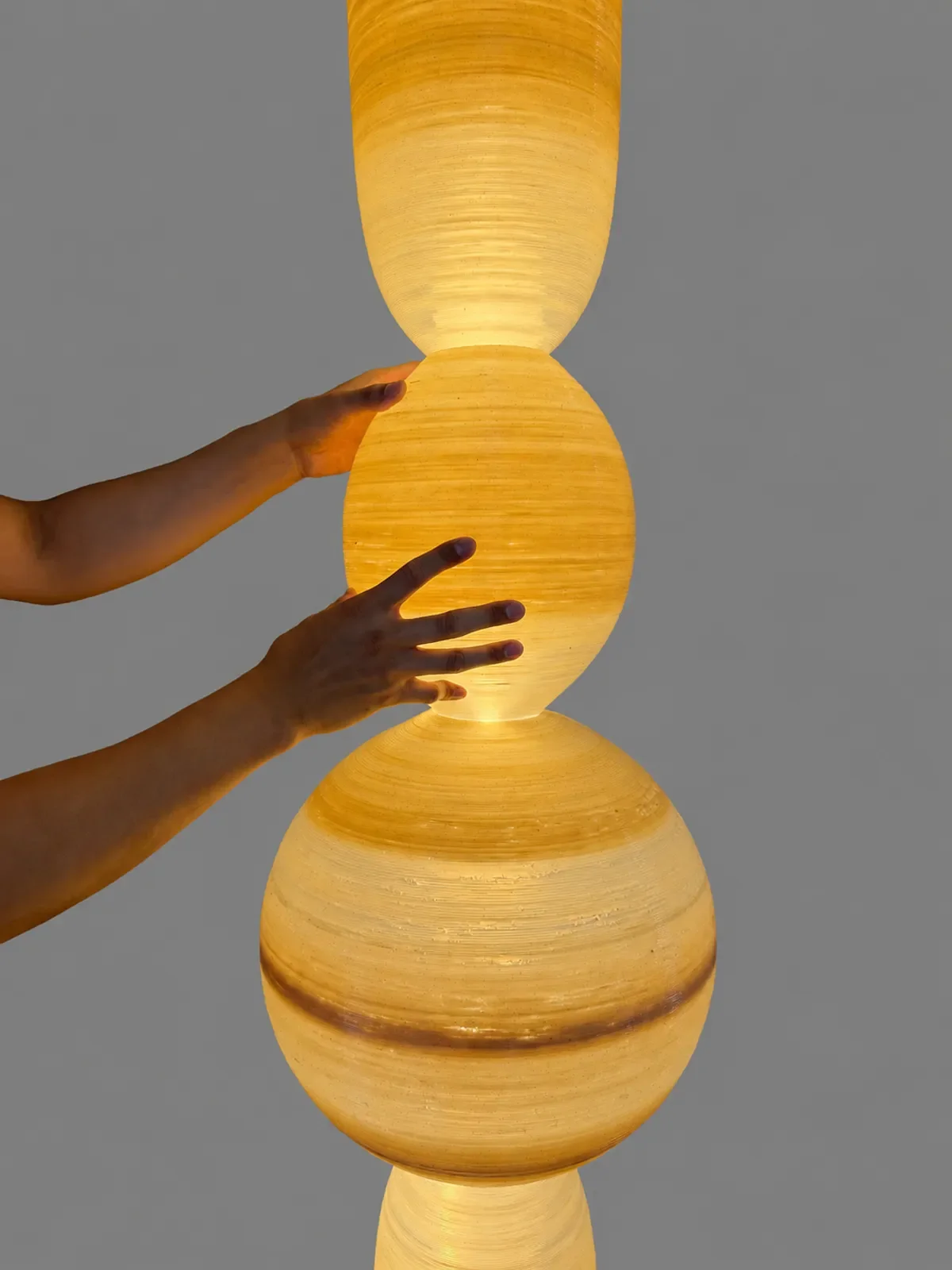
展覽中最醒目的作品之一,是高近兩米的模組化立燈 ORBIT。龔照峻從台灣傳統燈籠的圓潤輪廓與層疊形態汲取靈感,轉化為連續旋轉的立體曲面,全件以咖啡渣複合材料製作。關燈時,深褐色的材料保留咖啡渣原有的色澤與顆粒感;點亮內部 LED 光源後,光線穿透半透明的材料外殼,沿著列印層次形成明暗交錯的環形光影。隨著觀看角度改變,表面紋理也呈現不同的深淺變化,讓材料本身成為視覺表現的一部分。
[EN]
Turning Cultural Forms into Three Dimensions
In September 2026, Kung presented these material experiments in After the Last Sip, an exhibition held at Fab.Pub during London Design Festival. Initiated by Kung, with spatial curation by Chih-Han Liu, the exhibition brought together material samples, fabrication tools, furniture and lighting, tracing the process from discarded organic matter to finished objects.
One of the key pieces was ORBIT, a modular floor lamp standing nearly two metres tall. Inspired by the rounded, layered forms of traditional Taiwanese lanterns, Kung translated their silhouettes into a series of flowing curves made from the coffee-ground composite. When unlit, the dark brown surface reveals the colour and texture of the coffee grounds. Once illuminated by internal LEDs, light passes through the semi-translucent shell, revealing the printed layers and highlighting the material’s varied surface.
《After the Last Sip》 © ChaoChun Kung
ORBIT © ChaoChun Kung
[ZH]
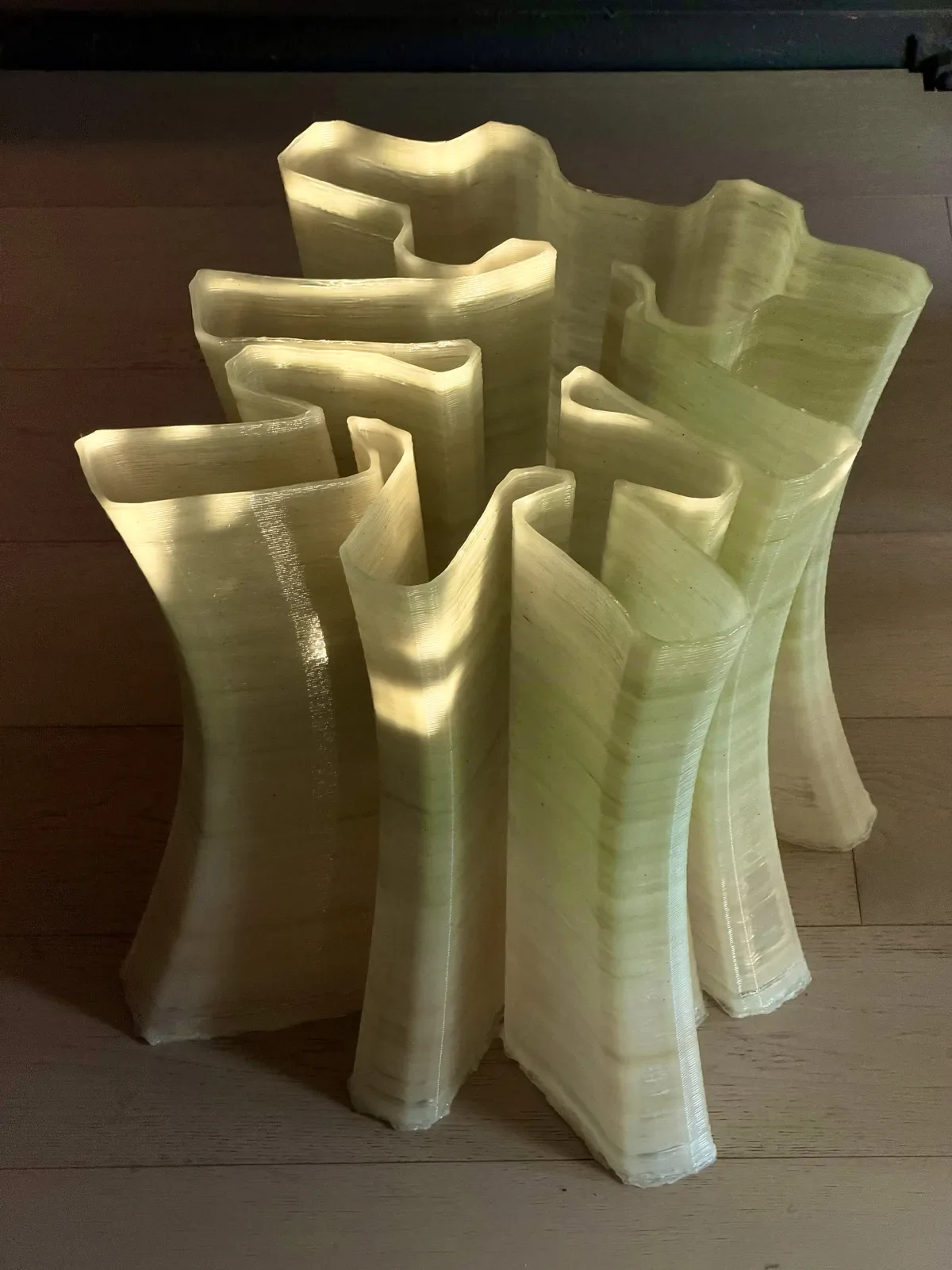
另一件由龔照峻獨立發展的 CHA 系列,則從漢字「茶」的字形出發。他透過參數化程式,將原本平面的文字筆畫轉化為三維空間曲線,再依照不同尺寸與幾何設定,延伸出椅凳、雕塑及置物台面等作品。漢字原有的橫、豎、撇、捺,在三維空間轉化成結構與外部輪廓。這項設計也將亞洲飲茶文化帶入家具語彙,使一個熟悉的漢字,經由計算設計與數位製造,發展出不同的空間尺度與使用形式。
[EN]
Kung’s independently developed CHA series takes the Chinese character 茶, meaning tea, as its starting point. Using parametric design, he translates the character’s two-dimensional strokes into three-dimensional curves, developing them into stools, sculptural objects and tabletop pieces. Through this process, the visual structure of the character becomes part of each form, bringing an element of Asian tea culture into contemporary furniture design.
CHA © ChaoChun Kung
[ZH]
結合不同視角,讓材料走向多元創作
《After the Last Sip》除了呈現龔照峻的個人創作,也集結台灣設計師林靖淯與張辰暘的合作作品,讓同一種複合材料在不同設計思考下,發展出各自的造型與用途。
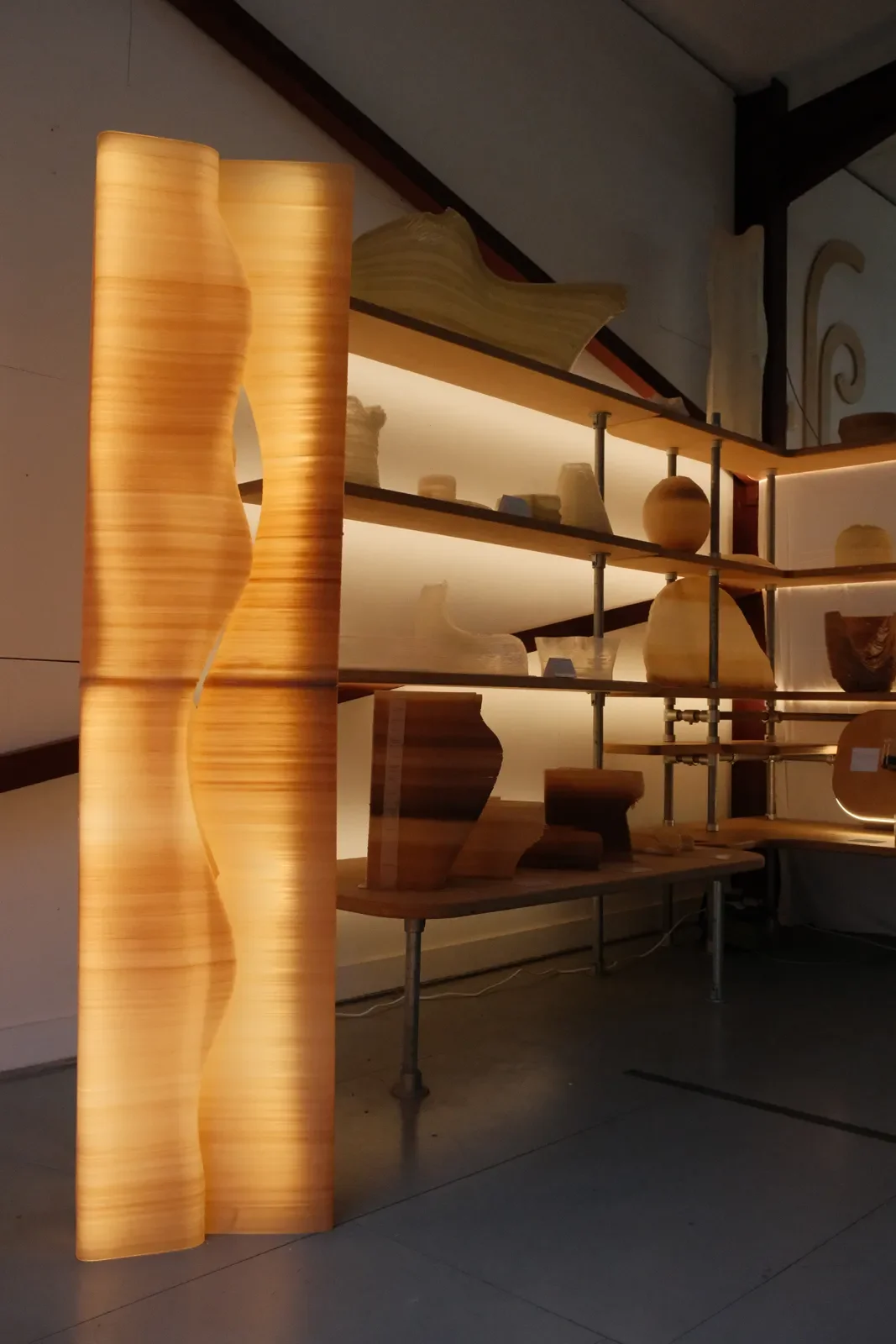
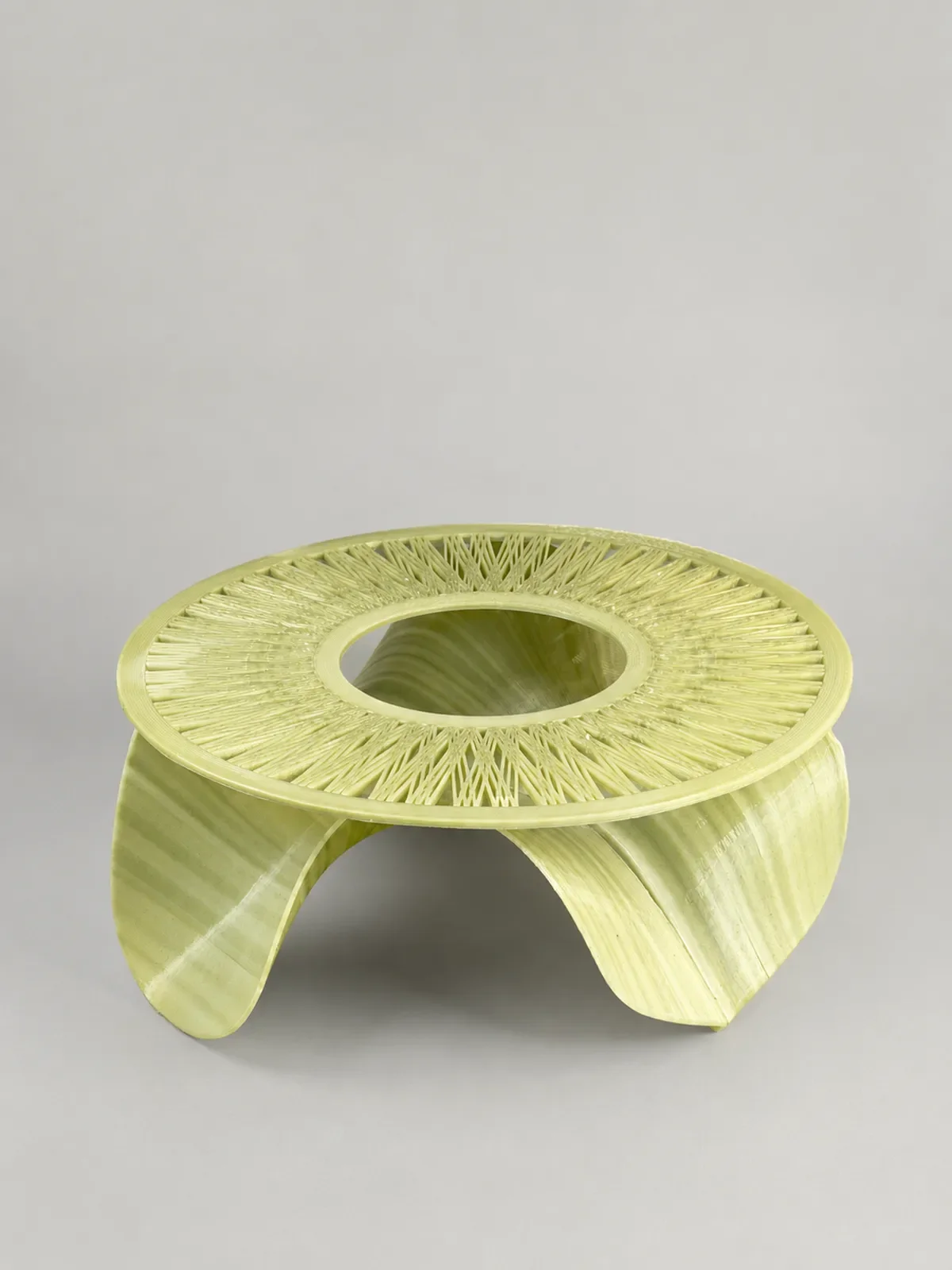
設計師林靖淯的光雕裝置 Undetermined Shore,將視角投向受潮浪沖刷與堆積重塑的台灣海岸線。作品結合回收咖啡渣複材與內嵌光源,由林靖淯構思造型,並與龔照峻合力完成材料測試與打樣。另一項合作則聚焦於曲面幾何的實體轉化,設計師張辰暘分別展出個人設計的 Unfolding Bloom,以及與龔照峻共同研發的低几 Nexus Bloom;後者擷取花瓣開展時的型態,透過連續曲面構成具有雕塑感的低桌。
這些合作展現了 Innovus Lab 的工作定位:除了發展自有家具與燈具系列,也透過材料研究及數位製造技術,與不同設計師、工作室及品牌合作,參與委託製作與空間計畫。展覽結束後,團隊獲選 Pith × London Design Festival Launch Pad Initiative 2026,後續將透過 London Design Festival 與 Pith 的平台持續曝光,讓作品與合作成果有機會接觸更廣泛的國際設計社群。
[EN]
Bringing Different Perspectives Together Through Collaboration
After the Last Sip also featured collaborative works by Taiwanese designers Ching-Yu Lin and Chen-Yang Chang, showing how the same composite material can take on different forms through distinct design approaches.
In Undetermined Shore, designer Ching-Yu Lin draws inspiration from Taiwan’s changing coastline, where erosion and sedimentation continually reshape the land. Combining the coffee-ground composite with lighting, the work explores forms and textures associated with this shifting landscape. Lin developed the design, while Kung worked with him on material testing and fabrication.
Designer Chen-Yang Chang presented two works in the exhibition. Unfolding Bloom was designed by Chang and fabricated by Kung, while Nexus Bloom was developed through their joint design process. Inspired by the unfolding forms of flower petals, the latter takes shape as a sculptural low table with continuous curved surfaces. Kung was responsible for its digital fabrication using the six-axis robotic arm.
These collaborations reflect another direction for Innovus Lab. Alongside its own material and product development, the studio works with designers and creative practitioners on material testing and digital fabrication, helping bring different design ideas into physical form.
Following the exhibition, Kung, Lin and Chang were selected for the Pith × London Design Festival Launch Pad Initiative 2026. The initiative offers a further opportunity for their work to reach the international design community through the platforms of London Design Festival and Pith.
Undetermined Shore © Hsin Huang
Nexus Bloom © ChaoChun Kung
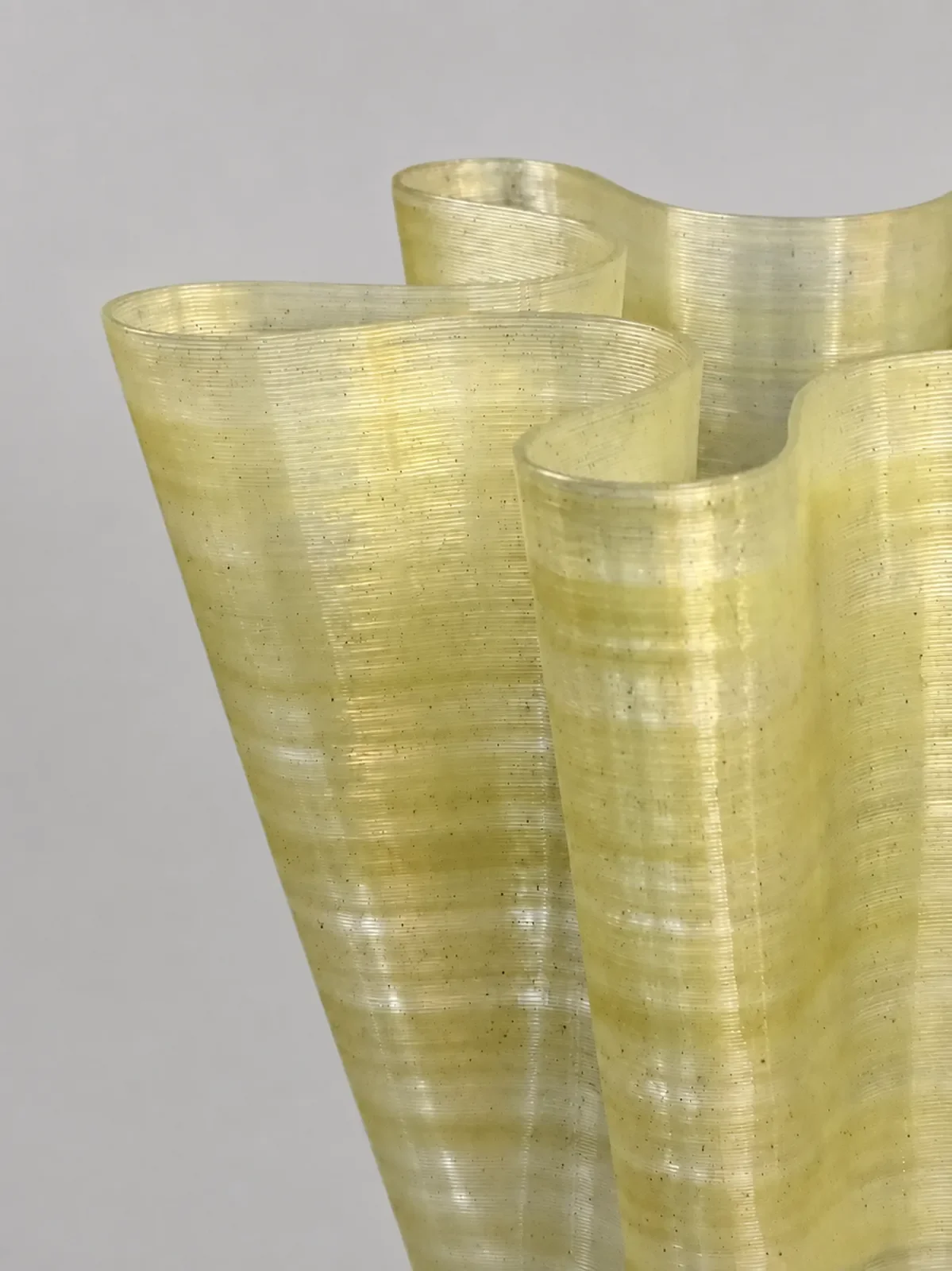
Unfolding Bloom © ChaoChun Kung
[ZH]
帶著材料的記憶,回到雲林老宿舍
目前,龔照峻正持續研究提高農業剩餘物在複合材料中的使用比例,並將材料來源逐步擴及台灣在地資源,包括疏伐木屑、阿里山茶葉與古坑咖啡渣,也將竹材納入研究,探索其纖維特性在複合材料中的應用。
隨著材料性能與製作流程逐步發展,龔照峻也開始思考如何讓這批作品進一步走入真實生活場域。他計畫於 2027 年 7 月將以茶葉與咖啡渣複合材料製作的家具及燈具帶回台灣,並安排在雲林斗南國小對面的日式老宿舍群展出,讓這項從材料實驗出發的創作,在不同的空間脈絡中展開新的使用想像。
這處日式宿舍群保留了木造建築、和室拉門與透光窗櫺,為作品帶來不同於倫敦展覽現場的背景。從材料處理、計算設計到機械手臂製造,這批家具與燈具經過一連串實驗與製作,最後回到龔照峻成長的雲林。新材料製成的物件進入帶有歷史痕跡的老屋,兩種不同時代的製作方式也在同一個空間裡相遇。
從雲林農田裡的稻草,到倫敦街角剩餘的茶葉與咖啡渣,龔照峻持續追索的是材料離開原有用途之後,還能延伸出哪些新可能。曾經被丟棄的剩餘資材,在新的製作過程中有了不同的形態,也有機會以另一種形式留在生活之中,成為家具、燈具,也走進不同的空間,延續下一段故事。
[EN]
A New Chapter in Historic Dormitories
Kung’s current research focuses on increasing the proportion of organic matter in the composite while exploring materials sourced from Taiwan. These include wood shavings from forest thinning, tea leaves from Alishan, coffee grounds from Gukeng and bamboo. By studying the characteristics of these local materials, he hopes to expand the possibilities of the composite and its applications.
Looking ahead, Kung plans to bring this body of work back to Taiwan in July 2027, with an exhibition in the historic Japanese-era dormitories opposite Dounan Elementary School in Yunlin. The project will present furniture and lighting made from tea and coffee composites, placing his material experiments within a different architectural setting.
From the rice fields of Yunlin to the cafés and tea shops of London, Kung’s research has followed the traces of materials left behind after their original use. The planned return to his hometown brings this journey back to where his interest in agricultural residues first began. Through new forms of fabrication, tea leaves and coffee grounds can find their way into furniture and lighting, continuing their journey in the spaces around us.
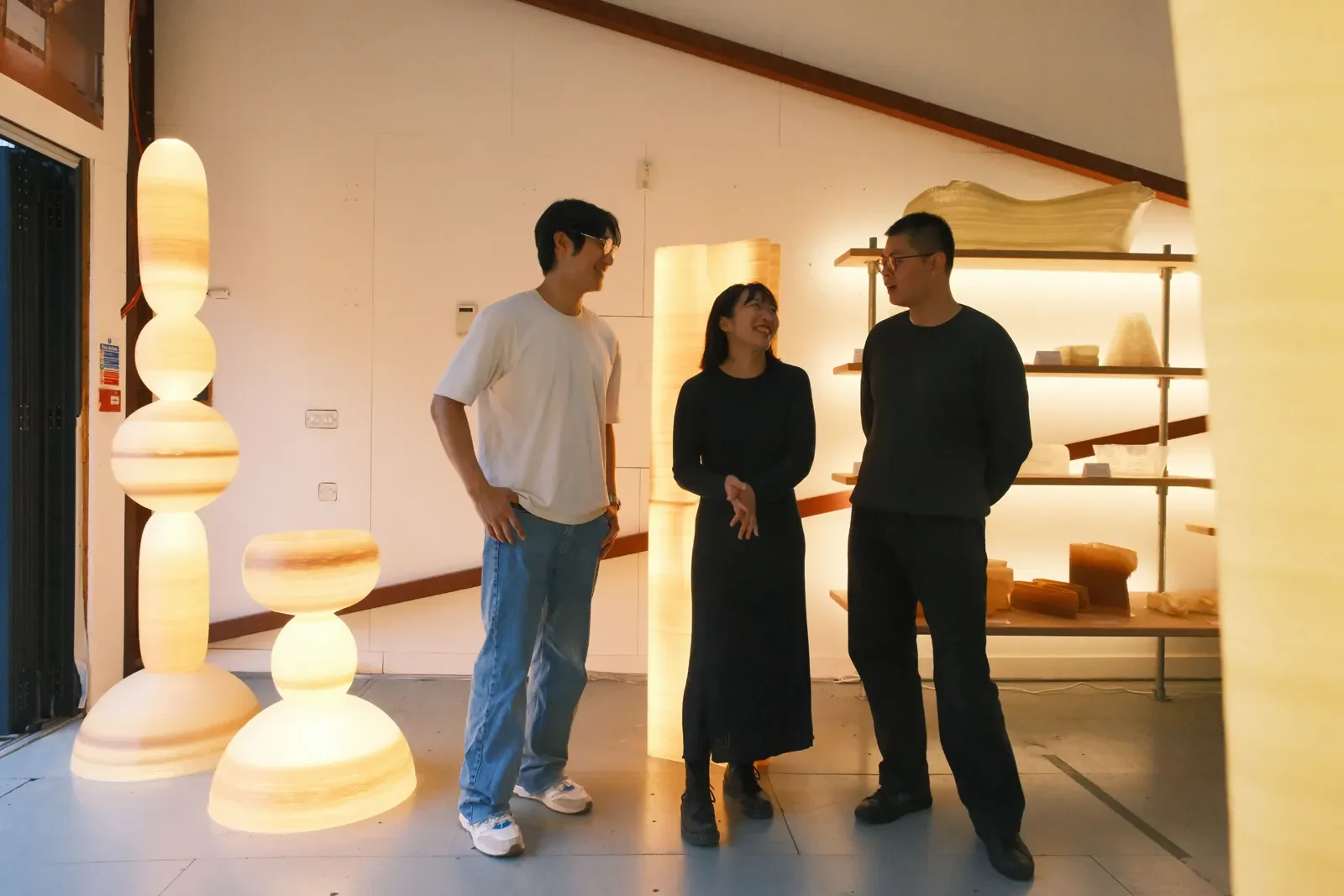
《After the Last Sip》展場合照,由左至右為龔照峻 ChaoChun Kung、劉芷含 Chih-Han Liu、林靖淯 Ching-Yu Lin。© Hsin Huang